Independent thought lab · AI risk and the human future

How deeply will AI reshape us, and what could go wrong?

AI may be the most consequential transition our species has faced. CUSP42 Labs measures where AI risk stands, simulates how AI could reshape societies, and asks what it means for humanity, with every assumption on the table.

CARI today 44.5/ 100 Beyond appetite AI risk across 70 questions, six dimensions · as of 1 October 2026 · daily updates soon →

Two questions

Risk and transformation, at the same depth.

Most attention goes either to the catastrophes or to the productivity. We think the transition has to be studied as one thing: the risks are part of how AI reshapes society, and the reshaping is where most of the risk lives.

The risk question

What could go wrong, how likely is it, and when?

Loss of control over critical systems. Misuse that lets a few do enormous harm. Accidents in AI-run grids, markets and food systems. AI-accelerated escalation between powers. The slow collapse of shared truth. We track the drivers, and we simulate the odds.
The human question

What happens to us when intelligence becomes abundant?

Work, careers and the ladders into the middle class. Institutions built for slower change. Meaning, agency and attention. What it means to be needed, and what remains distinctively human. We explore it with simulation, structured debate and thought experiments.

What we do

Measure. Simulate. Debate. Imagine.

Four ways into the same transition, each one public and free.

Measure

CARI Live

The Civilizational AI Risk Index: 70 anchored questions in six dimensions, from capability to misuse, scored since 2019; daily updates launching soon.

Simulate

MoralWorld Live

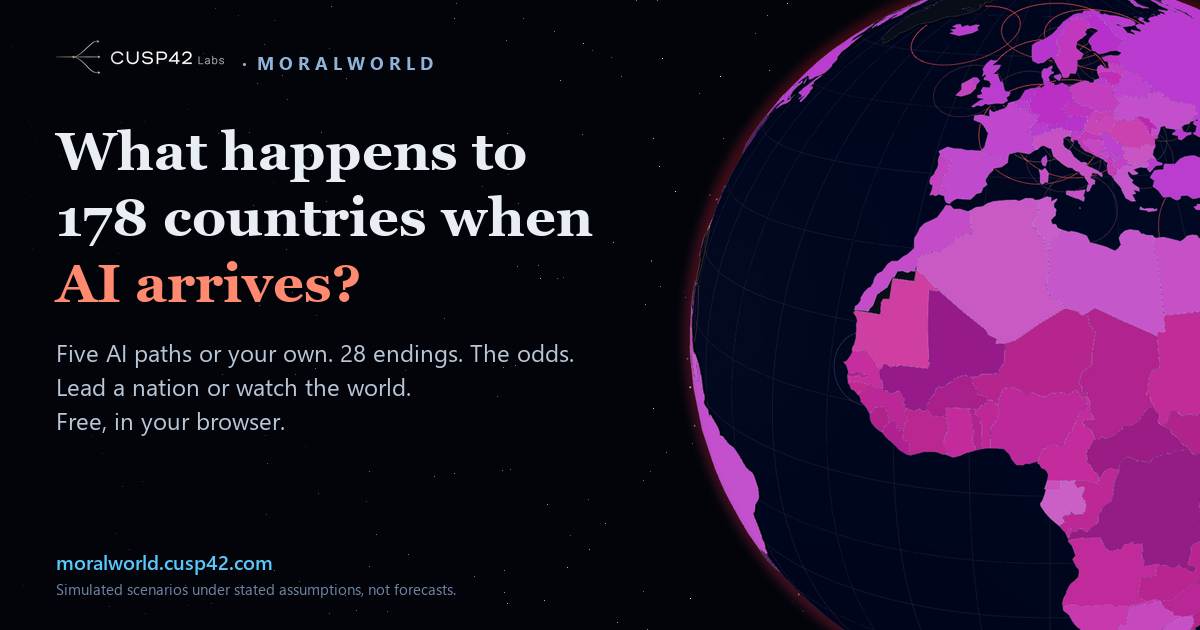
What happens to 178 countries when AI arrives: jobs, incomes, trust, institutions and catastrophes, quarter by quarter, with the odds of 28 endings.

Debate

Consensus Room Live

Several AI models argue the same question in rounds, on the record, before any conclusion: for questions where one fluent answer is too fragile.

Imagine

Thought experiments In development

The human question has no dataset yet: work, meaning, agency and what remains distinctively human, explored through structured thought experiments.

MoralWorld: a simulated globe

What a simulation shows

One future is an anecdote. The distribution is the result.

On today's AI trend, roughly one simulated future in three meets a global AI catastrophe before 2050. Most of the others are not catastrophes but deep, uneven change: broken career ladders, strained public finances, eroded trust, and in some, real shared prosperity. Which world we get depends on choices that are still open.

Scenarios under stated assumptions, not forecasts. Open the model, change one assumption, and see what happens.

How we work

Serious about uncertainty.

A thought lab earns trust by showing its working. These are the rules we hold ourselves to.

Scenarios, not forecasts

We show what stated mechanisms imply under stated assumptions. Change the assumptions and the future changes: that is the point.

Odds over anecdotes

One simulated history is one draw of luck. We report how often outcomes happen across many.

Assumptions in the open

Every index question has its anchors; every simulated change traces to a mechanism and a data source.

Neutral by design

One set of rules for every country; no regime labels; no country blamed for a war on our posters.

Humans decide

Our tools structure disagreement and expose assumptions. They do not hand judgment to a machine.

Independent

No sponsor's line to hold. The lab's views are its own.

Where risk stands

CARI, 2019 to today.

From about 9 in 2019 to 44.5 today: past the line of what institutions planned for. 60 marks the edge of tolerance, 80 the edge of capacity.

20199
202010
202112
202216
202323
202430
202538
202644

Next

What the lab is building.

Scenario Atlas · Human Agency Monitor · Thought Experiment Studio · Organisation Lab · Daily Transition Brief.